
Not long ago, artificial intelligence felt like something from a science fiction movie. Today, it is writing articles, creating artwork, answering questions, helping students complete assignments, and changing workplaces around the world.
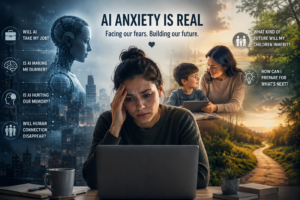 For some people, AI is exciting. For many others, it feels unsettling.
As a therapist, I have noticed more people carrying fears about artificial intelligence. They wonder whether their careers will survive. They worry that relying on AI may weaken their memory or critical thinking skills. Parents worry about the world their children are growing up in and whether technology will ultimately help or harm them.
If you have found yourself lying awake at night wondering what AI means for your future, you are not overreacting. AI anxiety is real. And perhaps most importantly, you are not alone.
What Is AI Anxiety?
AI anxiety refers to the fear, stress, uncertainty, or emotional distress people experience when thinking about artificial intelligence and its impact on our lives.
While media headlines often focus on dramatic scenarios, most people’s fears are much more personal:
- Will AI take my job?
- Will I become less intelligent if I depend on AI?
- Is technology damaging our memory and attention span?
- What kind of future will my children inherit?
- Will genuine human connection become less important?
- How can I compete with machines that seem to learn faster every day?
These concerns are understandable. We human beings are wired to feel uneasy during periods of rapid change, especially when that change affects our sense of security, identity, and purpose.
Many people are not simply afraid of technology. They are afraid of becoming irrelevant. That is a much deeper fear.
Why AI Feels Different from Previous Technologies
Throughout history, new technologies have sparked fear and uncertainty. People worried that the printing press would change how we learn. Some feared calculators would destroy mathematical ability. The internet raised concerns about privacy, misinformation, and shrinking attention spans.
Most of those concerns contained some truth while also missing the larger picture. Yet AI feels different because it appears to challenge something we have long considered uniquely human: intelligence itself.
AI can now assist with:
- Writing
- Research
- Coding
- Design
- Customer service
- Data analysis
- Problem-solving
For many people, this creates a profound emotional reaction. If a machine can do tasks I spent years learning, what does that mean about my value? That question sits underneath much of today’s AI anxiety.
Fear #1: “AI Will Take My Job”
This is one of the most common fears surrounding artificial intelligence. Perhaps you have watched AI write reports, generate images, answer customer inquiries, or perform work that once required a trained professional.
It’s natural to wonder: “Will there still be a place for me?”
The truth is that no one knows exactly how the job market will evolve. Some professions will change dramatically. Certain tasks will likely become automated.
But history offers an important perspective. When ATMs appeared, many predicted the end of bank tellers. When spreadsheets became common, people worried accountants would disappear. When online booking emerged, many assumed travel agents would become obsolete overnight.
What typically happens is more complicated. Jobs evolve. Some skills become less important while new skills become valuable.
The people who tend to thrive are often not the ones who resist change entirely. They are the ones who learn how to adapt while continuing to offer uniquely human strengths.
Those strengths include:
- Empathy
- Leadership
- Creativity
- Relationship-building
- Ethical judgment
- Strategic thinking
- Emotional intelligence
These are qualities that remain deeply human. And they matter more than many people realize.
Fear #2: “AI Is Making Me Dumber”
This fear is surprisingly common.
Many people now use AI to draft emails, summarize articles, brainstorm ideas, organize information, and solve problems.
Sometimes people tell me: “I worry I’m becoming dependent on AI.” That concern deserves attention.
Psychologists use the term cognitive offloading to describe our tendency to rely on external tools rather than storing or processing information ourselves. We already do this with:
- GPS systems
- Smartphones
- Search engines
- Calendars
- Contact lists
AI simply extends that pattern.
The danger is not using AI. The danger is allowing AI to replace thinking rather than support thinking.
Healthy AI use looks more like collaboration than dependency. You might use AI to generate ideas but still evaluate them yourself. You might ask it to summarize information while continuing to read deeply and think critically. Technology serves us best when it expands our abilities rather than replaces them.
Fear #3: “AI Is Destroying Human Memory”
Many people worry that memory itself is becoming weaker. Some notice they remember fewer phone numbers. Others struggle to recall information because answers are always available with a quick search. Now AI can provide instant summaries, explanations, and reminders.
It’s understandable to wonder whether our memory skills will continue to decline because memory strengthens through use, and the less we practice recalling information, the less efficient those pathways may become.
Yet we have always stored information outside our brains. We created books, magazines, journals, libraries, calendars, and computers.
The challenge is not avoiding technology altogether. The challenge is figuring out and maintaining balance, both individually and collectively.
You can support your memory by:
- Reading full books instead of only summaries
- Practicing recall rather than always looking things up
- Having meaningful conversations about what you learn
- Teaching concepts to others
- Staying intellectually curious
Think of memory like a muscle. Technology can assist it, but regular exercise still matters.
Fear #4: “What Will AI Do to My Children?”
For many parents, this is the most emotional concern of all. Parents wonder whether their children will grow up dependent on AI. They worry about shrinking attention spans, reduced creativity, social isolation, misinformation, and the loss of critical thinking skills.
Beneath these concerns is a profound question: “What kind of world are we creating for the next generation?” As a parent or grandparent, that question can feel heartbreaking. Yet there are reasons for hope.
Every generation grows up with technologies that previous generations feared: television, video games, the internet, smartphones, and social media. The determining factor is rarely the technology itself. What matters most is how children are taught to engage with it.
Children still need:
- Face-to-face relationships
- Outdoor play
- Creativity
- Reading
- Curiosity
- Problem-solving
- Emotional intelligence
- Parents’ full attention
Parents need to be role models while with their kids and not favor their tech devices over attention paid to their children.
When these foundations remain strong, technology becomes a tool rather than a substitute for life.
Fear #5: “AI Will Make Human Beings Less Important”
This may be the deepest fear of all. Many people derive a sense of identity from what they contribute. They want to matter. They want to know their skills, talents, and efforts have value. When AI appears capable of performing increasingly complex tasks, people sometimes begin questioning their own significance.
But human worth has never been limited to productivity. Your value is not measured solely by what you produce.
Human beings matter because we:
- Love
- Empathize
- Create meaning
- Support one another
- Raise families
- Build communities
- Make ethical choices
- Experience beauty, wonder, and awe
No technology can replace the experience of being human. AI may change how we work. But it cannot replace why we matter.
Practical Ways to Cope with AI Anxiety
1. Limit AI Doomscrolling
Fear grows when we consume endless predictions about catastrophic futures. Seek balanced information rather than emotionally charged headlines.
2. Focus on What You Can Control
You cannot control the future of technology. But you can control your willingness to learn, adapt, and grow.
Invest time and effort into skills such as:
- Good communication
- Adaptability
- Emotional intelligence
- Leadership
- Critical thinking
3. Learn About AI Instead of Avoiding It
Fear often grows in the absence of understanding. Many people feel less anxious after spending time exploring AI tools and learning what they can and cannot do.
4. Stay Connected to Other People
Anxiety thrives in isolation. Talk with friends, coworkers, family members, or a therapist about your concerns. You may discover that many people share the same fears and, like you, want workable solutions.
5. Remember That Human Beings Are Remarkably Adaptable
History is filled with periods of technological disruption. Human beings have consistently found ways to adapt, innovate, and create meaning despite uncertainty. There is every reason to believe we will continue to do so.
The Future Is Not Written Yet
Artificial intelligence will undoubtedly shape the future. Some jobs will change. New opportunities will emerge. Certain skills may become less important while others become more valuable. There will be challenges. But there will also be creativity, resilience, and human ingenuity.
If you are experiencing AI anxiety, remember this: feeling worried about rapid change does not mean something is wrong with you. It means you care about your future, your family, and your place in the world.
The goal is not to eliminate uncertainty. The goal is to build enough confidence, adaptability, and self-trust to navigate whatever comes next. Even though artificial intelligence may influence the future, human beings still have tremendous power in shaping what that future becomes.
And that story is still being written.
Frequently Asked Questions About AI Anxiety
Is AI anxiety normal?
Yes. Many people experience anxiety about artificial intelligence, particularly concerns about job loss, privacy, memory decline, and the future of society.
Can AI really replace human jobs?
AI can automate certain tasks, but most jobs require human judgment, communication, creativity, empathy, and relationship-building. Many careers will evolve rather than disappear entirely.
Does using AI weaken memory?
Overreliance on any tool can reduce practice of specific mental skills. Balanced use combined with active learning and critical thinking helps maintain cognitive health.
Should parents worry about AI?
Parents should stay informed and help children develop healthy technology habits. Strong relationships, critical thinking skills, and real-world experiences remain protective factors.
How can I reduce AI anxiety?
Learning about AI, limiting fear-based media, strengthening adaptable skills, maintaining human connections, and focusing on what you can control are all effective ways to cope with AI anxiety.