
This is the most personal newsletter I have written since I began sending them. It comes from a place of deep love and deep grief.
 Last month my dear cat Max died in my arms at the age of fifteen and a half. My husband and I chose home euthanasia so that Max could pass peacefully in the place he loved most. He slipped away gently while I held him.
If euthanasia is the compassionate choice for a pet, I strongly recommend considering it at home. Max had long disliked veterinary clinics, and even if that had not been the case, I would still have wanted his final moments to take place in his favorite room, surrounded by familiar sounds, smells, and love.
Max lived a good life, though his final year was difficult for both of us. I miss him dearly. During that last year I gave him six different heart medications, three times each day. He did not enjoy the routine, but I believe it gave him more time and comfort.
How Max Came Into Our Lives
Sixteen years ago my husband and I went from three cats, to two, to one. Our remaining cat, Bebe, had always lived with other cats and seemed lonely. I wanted to find her a companion.
One day our veterinarian told us about a young cat who had been left at their clinic and was available for adoption. The staff had named him “Lone Ranger.” He had been adopted by someone who was later forced to return him because pets were not allowed in his apartment.
Max was only six months old when he came home with us. Tragically, he had spent most of those first months living in a cage at the veterinary clinic. It was a sad way to begin life, and he never forgot it. Veterinary clinics remained frightening places for him.
What truly won me over, beyond his adorable face, was something the vet shared with us. Earlier that day she had been forced to euthanize a kitten and was visibly upset. Max approached her and gently licked her face as if he knew she needed comfort. Even then he seemed unusually sensitive to human emotion.
A Difficult Beginning With Bebe
 Unfortunately Max and Bebe did not get along.
We introduced them slowly and carefully. They sniffed each other under a closed door. We offered treats when they behaved calmly. We followed every guideline for introducing cats.
Still, their relationship was tense from the start.
The first time we allowed them in the same room together they fought fiercely. During the scuffle Bebe knocked Max off a kitchen ledge and he dislocated a toe. He had to wear a boot and spend time confined to a kennel while healing.
Once again, Max found himself caged.
For years we tried everything imaginable to help the two cats coexist. We worked with a cat behaviorist. We experimented with reward systems. At one point we even consulted a cat psychic. We bought a so called “cat taming cage.” Mostly we relied on patience.
Despite all of this, we ultimately had to keep the two cats separated.
Max Becomes a Therapy Cat
 When Max was about eight months old I began bringing him to my therapy office. It helped ease the tension at home and gave him a space where he could move freely.
Something remarkable happened.
Max became a therapy cat.
He would sit quietly on a chair or in my lap while I met with clients. If someone was in emotional pain, he often seemed to notice. Slowly he would walk toward the client, pausing halfway as if sensing whether the person might welcome his presence. If they appeared comfortable, he would settle at their feet.
Many clients found great comfort in his presence.
Over time Max earned a new name in the office: Dr. Maxwell Katz, therapy assistant.
Anyone who loves cats knows how attuned they can be to human emotions. There is something deeply soothing about the gentle vibration of a purring cat resting on your lap or chest. Max offered that kind of quiet healing to many people.
Our Morning Walks
When Max was very young I began training him to wear a harness and leash so he could safely explore outdoors.
Within a few weeks he mastered it.
Soon we were walking together every morning, often before sunrise. Max would trot beside me for more than a mile through the neighborhood. He loved these outings, though hills were not his favorite. He would climb them slowly but determinedly.
In colder weather he even tolerated wearing a small sweater.
During the last six months of his life our walks became shorter. Eventually they turned into slow wanderings through the grass where he could sniff bushes and watch insects. Even those quiet moments felt precious.
The Cat Who Thought He Was a Dog
 Max had many doglike qualities. Before him I had shared my life mostly with dogs, and in some ways he fit right in.
He developed strong separation anxiety because he spent so much time with me, both at home and in my office. If I left the house for several hours he would sit by the front door waiting for my return.
My husband would send me videos of Max sitting there, crying softly.
When I came home Max would greet me with a relieved cry and then remain by my side for the rest of the day. Eventually I realized I had developed a bit of separation anxiety too. Leaving him for long periods felt difficult.
Our bond ran deep.
Max’s Final Day
I had always hoped that Max would die peacefully beside me, or even in my arms. In his final weeks I worried that he might suffer a heart attack during one of our walks, even though I carefully followed his cues and carried him home whenever he seemed tired.
On his last day the veterinarian who performed home euthanasia could not arrive until evening.
The weather was beautiful, so I took Max outside. He sat on the grass and later on my lap, enjoying the warm air and quiet afternoon. I knew he was uncomfortable and having digestive trouble, and I worried that he might die before the vet arrived.
At one point he vomited the food he had eaten that day. It was distressing, but afterward his stomach settled and he seemed calmer.
Not long after that the veterinarian arrived and gave him a sedative.
My husband and I said our goodbyes. Even though Max was nearly asleep, we spoke to him gently. Animals can still hear the voices they know and love.
I held him on my lap as the vet administered the final medication. Within moments his breathing slowed and his heart quietly stopped.
He died in my arms.
The Quiet That Follows
After a long day of anticipating his passing, everything changed suddenly. One moment he was there. The next moment he was gone.
The veterinarian took Max with her for cremation. I kept a small tuft of fur that had been shaved from his leg for the injection. That was all that remained physically.
The shock of that moment was profound.
Yet there was also gratitude. Max had passed peacefully, held in loving arms, in the home where he felt safe.
It was a gift for both of us.
When a Beloved Pet Dies
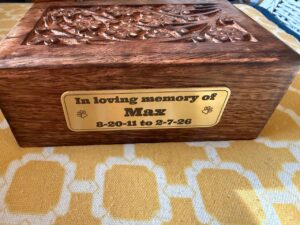 Grieving the death of an animal companion can be deeply painful. In some ways it can feel even harder than grieving a human loss.
Pets offer something rare in this world. They are present. They are loving. They ask very little and give so much. Their affection is steady and uncomplicated.
Losing that presence leaves a quiet space in the heart.
If you have experienced the death of a beloved pet, please know that your grief is real and worthy of care.
And if you feel moved to share a story about your own cherished animal companion, I would be honored to hear it