
We are living in an information environment that our brains were never designed to navigate.
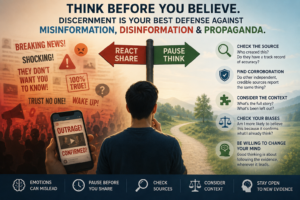 Every day, we encounter breaking news, social media posts, podcasts, political messages, advertisements, YouTube videos, AI-generated content, forwarded emails, memes, and commentary presented as fact. Some of this information is accurate. Some is mistaken. Some is deliberately misleading. And increasingly, artificial intelligence can create photographs, videos, and voices that appear remarkably real even when the events depicted never happened.
For individuals and families, this creates an increasingly important question: How can we identify misinformation, disinformation, and propaganda before they influence what we believe?
The answer cannot simply be “trust the media,” “don’t trust the media,” or “trust the experts.” Nor is it helpful to assume that everything we disagree with is propaganda.
What we need instead is discernment: the ability to evaluate information thoughtfully, recognize manipulation, check sources, tolerate uncertainty, and remain open to changing our minds when better evidence becomes available.
These skills are becoming essential forms of media literacy and critical thinking, not only for adults but also for children and teenagers growing up in a world of social media, artificial intelligence, deepfakes, influencers, and algorithmically selected information.
What Is Misinformation, Disinformation, and Propaganda?
Understanding the differences between these terms is the first step toward recognizing them.
What Is Misinformation?
Misinformation is false or inaccurate information that may be shared without an intention to deceive.
For example, someone may read an inaccurate health claim online, believe it is true, and send it to friends and family with the sincere intention of helping them.
What Is Disinformation?
Disinformation is false or misleading information that is deliberately created or distributed to deceive or manipulate people. The goal may be political influence, financial gain, social disruption, reputation damage, or simply attracting attention and generating online engagement.
What Is Propaganda?
Propaganda is communication intended to influence people’s beliefs, emotions, attitudes, or behavior in support of a particular cause or agenda. Propaganda does not necessarily consist entirely of lies. In fact, effective propaganda may contain real facts, authentic photographs, or accurate statistics that are selectively presented or removed from context to create a particular emotional conclusion. That is why simply asking, “Is this technically true?” is sometimes insufficient.
We also need to ask:
What information has been left out?
How is this information framed?
What does the person presenting it want me to believe or do?
Why Disinformation and Propaganda Are So Effective
We often assume that people believe misinformation because they lack intelligence or education. But human psychology is much more complicated.
Propaganda frequently works by activating emotions before we have time to evaluate evidence, emotions of:
Fear.
Anger.
Disgust.
Outrage.
Humiliation.
And also tribal loyalty, a sense of threat, or feeling that something terrible is happening and immediate action is necessary.
Strong emotions do not mean that information is false. There are real situations that deserve fear, grief, anger, and action. Yet, intense emotional activation is an important signal to slow down before believing or sharing something.
The Connection Between the Nervous System and Critical Thinking
When we feel threatened, our nervous system naturally prepares us to respond. Our attention narrows. We become more focused on danger. We may feel an urgent need to act.
These responses can be useful when we are facing an immediate physical threat. But they are much less useful when we are trying to determine whether a viral video or alarming headline is accurate.
Before reacting, notice what is happening inside your body. Ask yourself:
What am I feeling right now?
Is this information creating urgency or fear?
What is this message encouraging me to believe or do?
Sometimes taking even a few minutes before responding can dramatically change how we interpret information.
How to Recognize Common Propaganda Techniques
Propaganda has existed for centuries, but today’s digital environment allows emotionally powerful messages to spread globally within minutes.
Common propaganda techniques include:
1. A common propaganda technique and warning sign includes creating an “us versus them” mentality. People become divided into opposing camps. One group is portrayed as intelligent, moral, patriotic, awakened, or virtuous. The other is portrayed as stupid, dangerous, corrupt, evil, or less than human.
2. Repeating a message until it feels true. Repeated exposure creates familiarity, and familiarity can sometimes be mistaken for credibility. Seeing the same claim dozens of times does not necessarily mean that dozens of independent sources have verified it. They may all be repeating the same original claim.
3. Appealing to fear and anger. Messages designed to produce outrage or terror spread rapidly because people feel compelled to warn others.
4. Oversimplifying complicated problems. Complex political, economic, medical, or social problems are attributed to a single person, group, or cause.
5. Attacking anyone who questions the narrative. Instead of addressing evidence, critics are dismissed as stupid, corrupt, brainwashed, dangerous, or part of the conspiracy.
6. Claiming exclusive access to the truth. Be particularly cautious when a person, organization, political movement, or online community suggests: “Everyone else is lying to you. We are the only ones telling you the truth.” Or, “Anyone who disagrees with us has been brainwashed.”
Healthy sources can withstand questions.
How to Identify Misinformation on Social Media
Social media has made information available faster than at any previous time in human history. It has also made misinformation easier to spread. A claim can travel around the world before anyone verifies whether it is accurate.
Before believing or sharing a viral post, video, photograph, or headline, ask yourself:
Who originally created this?
Where did this information come from?
Can I find the original source?
Are other independent sources confirming it?
Is the headline accurately describing the underlying story?
Is the account providing evidence or simply making assertions?
Is someone selling something or benefiting financially from my attention?
One of the most important principles of digital media literacy is: popularity is not evidence.
Millions of views, thousands of shares, and hundreds of supportive comments do not establish that something is true.
Go to the Original Source Whenever Possible
One of the best ways to protect yourself from misinformation is to go upstream.
Suppose a social media post says that a scientific study proved something extraordinary. Find the actual study if possible. If a video shows ten seconds of someone’s speech, look for the complete speech. If an article quotes a government report, find the report. If someone claims that a public figure said something shocking, look for the original interview, transcript, recording, or statement.
Every layer between you and the original information introduces another opportunity for misunderstanding, selective interpretation, or manipulation.
How to Spot AI-Generated Misinformation, Deepfakes, and Manipulated Media
Artificial intelligence is changing the meaning of the phrase “seeing is believing.”
AI technology can now generate or manipulate:
- Photographs
- Video
- Human voices
- Documents
- News-style articles
- Social media accounts
- Screenshots and quotations
This means we increasingly need to ask two separate questions:
1. Is this photograph, recording, or video authentic?
2. Does it actually prove what the person sharing it says it proves?
Even authentic photographs and videos can be misleading. A real photograph from an event five years ago can be reposted as though it happened yesterday. A genuine video can be edited to remove important context. An authentic quotation can be presented in a way that completely changes its meaning.
As AI-generated misinformation becomes more sophisticated, source verification and context become more important than appearance alone.
Beware of the Urgency Trap
One of the most effective techniques used in online misinformation is urgency.
“Share this before it gets deleted.”
“Send this to everyone you know.”
“The media won’t tell you this.”
“Your family could be in danger.”
“You need to act immediately.”
Urgency discourages reflection.
Unless you are dealing with an actual emergency, give yourself permission to wait. Ten minutes.
An hour. Sometimes a day.
False stories frequently begin unraveling after independent journalists, researchers, witnesses, or other independent sources have had time to investigate.
Confirmation Bias: Why We Believe Information That Supports Our Views
One of the most important concepts in understanding misinformation is confirmation bias. Confirmation bias is our tendency to notice, remember, and accept information that supports what we already believe while being more skeptical of information that challenges our worldview. All human beings do this to some degree.
A powerful question to ask yourself is: Would I require the same amount of evidence if this story supported the opposite political, social, or cultural position? If the answer is no, confirmation bias may be influencing your judgment.
Ironically, the information that perfectly confirms everything we already believe may deserve more scrutiny, not less.
How to Protect Children and Teenagers from Online Misinformation
Children and teenagers are growing up in an environment in which information, entertainment, advertising, influencer culture, and political persuasion can be difficult to distinguish. Trying to protect your children by simply telling them what to believe is unlikely to prepare them for this world. Instead, teach them how to evaluate information.
Teach Children to ask “How Do We Know?” Make this question normal in your household: “How do we know this is true?” Then, explore the answer together.
Who made the claim?
What evidence did they provide?
Can you find another source?
Is someone trying to sell something?
Is the person an expert in the subject they are discussing?
Could the image or video have been manipulated?
Teach Children that Followers are not the Same as Expertise
Someone may have millions of followers and know very little about the subject they are discussing. Another person may have spent decades studying the subject and have almost no social media presence. Teach children to distinguish between popularity, confidence, expertise, and evidence. They are not the same thing.
Create a Family Rule: Verify Before You Share
Families can adopt one simple rule: We don’t forward alarming information until we verify it. This applies especially to frightening health warnings, crime alerts, political claims, financial scams, sensational videos, and supposed emergency announcements.
When information comes from someone we love, we naturally lower our defenses. That means each of us has a responsibility to be careful about what we pass along.
What to do When a Family Member Believes Misinformation or Conspiracy Theories
Disinformation can become a relationship problem when family members develop radically different understandings of reality.
If someone you love believes something you think is demonstrably false, humiliation usually makes the situation worse. Calling someone gullible, stupid, crazy, or brainwashed may push them further toward the online community that tells them: “Your family doesn’t understand you. We do.”
Instead, consider asking:
“What convinced you?”
“Where did you first hear this?”
“Would you be willing to look at the original source with me?”
“What evidence would cause you to reconsider this belief?”
You can disagree without abandoning the relationship. In some circumstances, maintaining human connection may be one of the strongest protections against increasingly isolated and extreme belief systems.
Watch for Closed Information Systems
One of the most concerning patterns occurs when a person becomes convinced that virtually everyone outside a particular group is untrustworthy. The media cannot be trusted. Scientists cannot be trusted. Doctors cannot be trusted. Government cannot be trusted. Family members are brainwashed. Friends who disagree are “asleep.”
Anyone presenting contradictory evidence is supposedly part of the conspiracy. This creates a closed information system.
Similar dynamics can occur in cults, coercive groups, abusive relationships, extremist movements, and other environments in which control over information becomes a means of controlling people.
A psychologically healthy community allows questioning. Healthy leaders tolerate disagreement. Healthy relationships do not require people to surrender their perception of reality.
A 10-Question Misinformation and Propaganda Checklist
Before believing or sharing an important claim, ask:
- Who originally made this claim?
- What evidence supports it?
- Can I locate the original source?
- Are multiple independent and credible sources confirming it?
- Is the message trying to make me frightened, angry, disgusted, or urgently reactive?
- What information or context might be missing?
- Could the photograph, audio, video, quotation, or screenshot have been manipulated or generated by AI?
- Who benefits if I believe or share this?
- Would I require the same evidence if the claim supported the opposite of what I believe?
- Am I willing to say, “I don’t know yet”?
That final question is surprisingly powerful.
Don’t Let Healthy Skepticism Become Cynicism
There is another danger in the age of misinformation. We can become so suspicious that we stop believing anything. If every journalist is lying, every expert is corrupt, every institution is compromised, every photograph is fake, and every contradictory fact is propaganda, we have not achieved discernment. We have simply entered another closed information system.
Healthy skepticism asks for evidence.
Cynicism assumes deception before examining the evidence. The goal is not unquestioning trust. Nor is it unquestioning distrust. The goal is learning to evaluate evidence while remaining capable of changing our minds.
Protect Your Mind and Your Family Without Living in Fear
None of us will successfully identify every piece of misinformation or propaganda. We will sometimes believe things that later turn out to be wrong. We may trust a source that disappoints us. We may share something and later discover it was inaccurate.
The important question is whether we remain capable of correcting ourselves.
Can we say:
“I was wrong about that.”
“I need more information.”
“I don’t know.”
“The evidence changed my mind.”
These are not signs of weakness. They are signs of intellectual and psychological flexibility.
Discernment Is a Form of Psychological Freedom
We cannot prevent governments, corporations, political organizations, advertisers, influencers, media organizations, foreign actors, artificial intelligence systems, and other individuals from trying to influence what we believe. But we can make ourselves and our families more difficult to manipulate.
We can slow down before reacting. We can investigate original sources. We can compare independent accounts. We can recognize emotional manipulation and common propaganda techniques. We can become more aware of confirmation bias. We can teach our children how to identify misinformation online. We can question information that supports our existing beliefs just as carefully as information that challenges them. And we can preserve the ability to say three extraordinarily important words: “I don’t know.”
Protecting yourself and your family from disinformation and propaganda does not require knowing the truth about everything. It requires developing a culture of curiosity in which questions are welcomed, evidence matters, disagreement does not automatically destroy relationships, and no person, political movement, media source, spiritual leader, or organization is given unquestioned authority over reality.
In an age of social media, artificial intelligence, deepfakes, information overload, and increasingly sophisticated propaganda, learning how to discern what is true may be one of the most important forms of psychological freedom we can give ourselves and the next generation.
When Information Overload Begins Affecting Your Well-Being
For some people, constant exposure to frightening news, political conflict, mis and dis-information, social division and uncertainty can contribute to chronic anxiety, anger, helplessness, and a feeling of being perpetually on alert. Psychotherapy can provide a place to explore these reactions without being tol what you should believe. It can help you understand how fear affects your nervous system, strengthen your capacity for discernment, tolerate uncertainty, establish healthier boundaries with information, reconnect with your values and inner soul wisdom, and help you help your family members with their own confusion, uncertainties, and anxieties.
At Soul Wisdom Therapy, I work with people seeking a more grounded, thoughtful, and emotionally balanced way of navigating a world that can often feel confusing, divided, and overwhelming. Together, we can create a space where you do not have to be told what to think or believe but can instead learn to trust your own capacity for discernment, understand your emotional reactions, reconnect with your deepest values and inner wisdom, and respond to the uncertainty around you with greater clarity and confidence.
If you are struggling with anxiety, information overload, conflict with people you love, or simply trying to find your footing in a rapidly changing world, therapy can offer a place to step out of the noise, hear yourself more clearly, and discover what feels genuinely true and meaningful for you.